CHACO CANYON 0.5m LIDAR, HABS NO. NM-30 (LOC nm0107) & NPS ARCHAEOLOGICAL ATLAS
Grounded in OpenTopography 0.5m Airborne LiDAR (OT.042019.6342.1), Historic American Buildings Survey HABS No. NM-30 (Library of Congress Control No. nm0107 / Call No. HABS NM,23-CHACA,1-), and U.S. National Park Service (NPS) Surveys
0.5m Airborne LiDAR Breakdown: DSM, Bare-Earth DEM, Scrub Foliage & Standing Masonry Relief
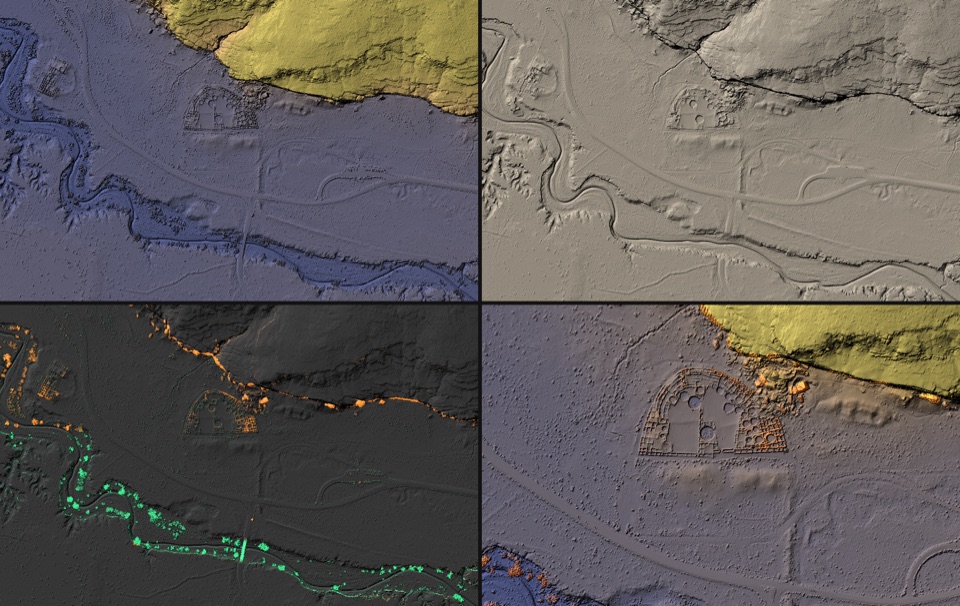 OpenTopography 0.5m LiDAR (OT.042019.6342.1): DSM, DEM & Foliage Breakdown
 Stage 01: True 50cm Airborne LiDAR Elevation Sweep (EPSG:6342 UTM 13N)
Aerial Overview: D-Shaped Great House, Dual Courts & Stratified Chacra Mesa Cliff
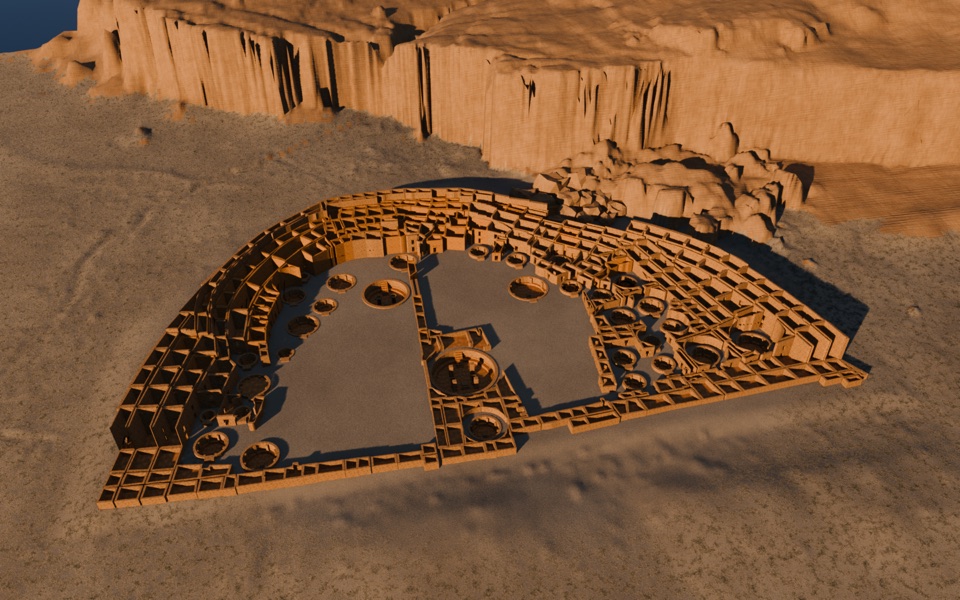 Blender 5.2 Render (1024px Spectral PBR & AgX Lighting)
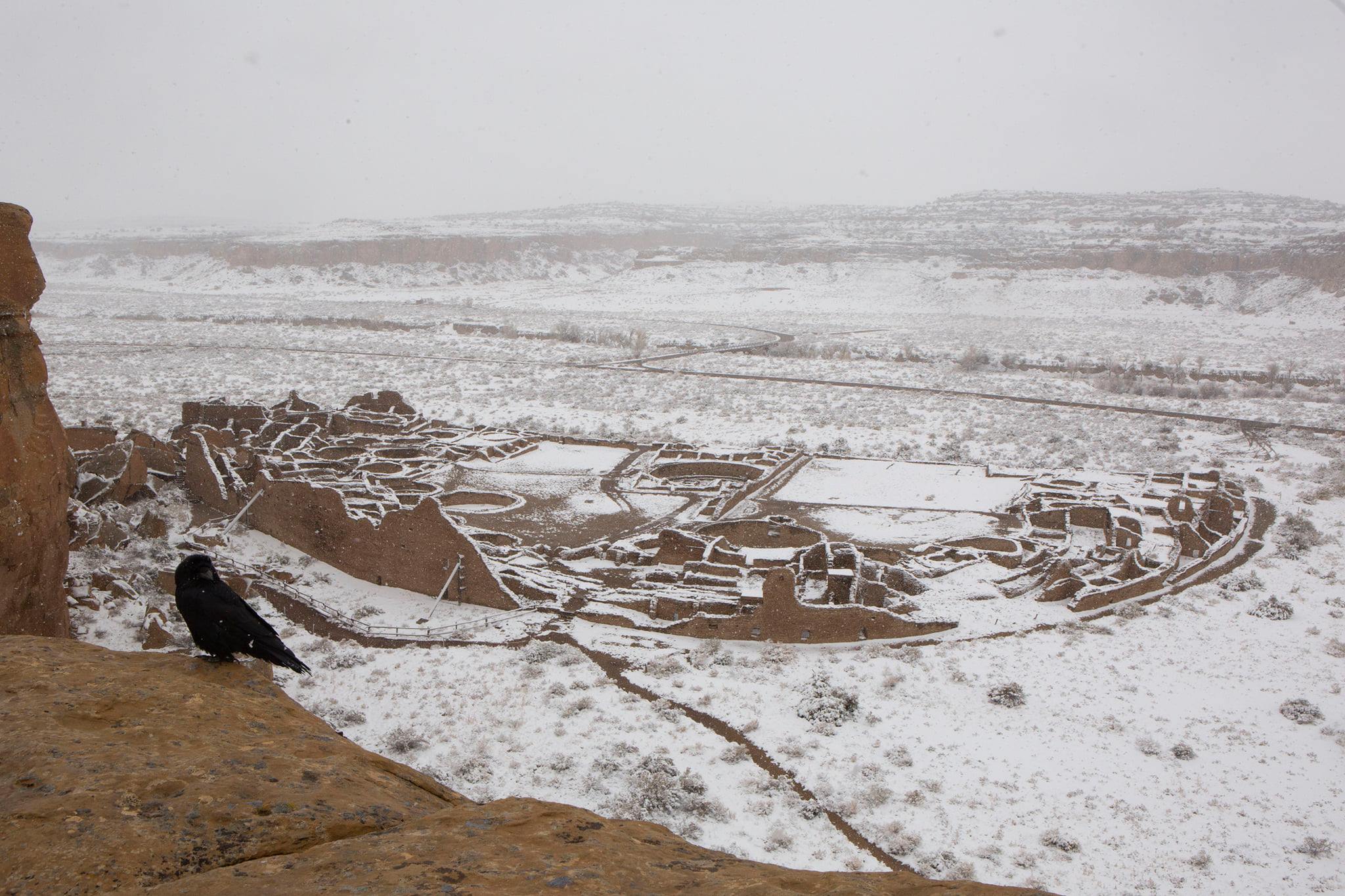 National Park Service (NPS) Cliff-Top Overlook Reference (Public Domain)
Measured NPS Architectural Floorplan vs. Great Kiva A Sanctuary
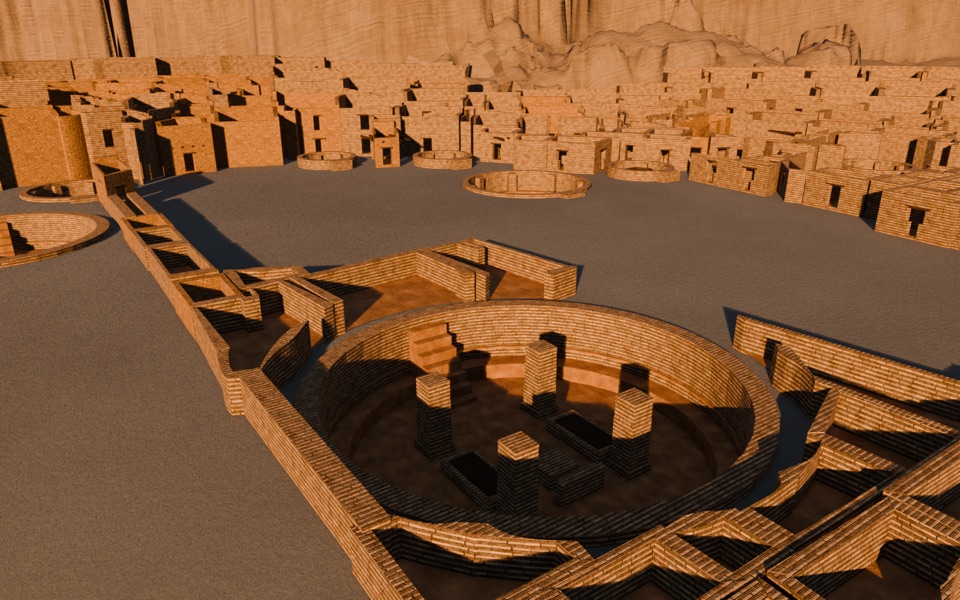 Great Kiva A: Type III Banded Veneer, 4 Square Masonry Columns & Subfloor Vaults
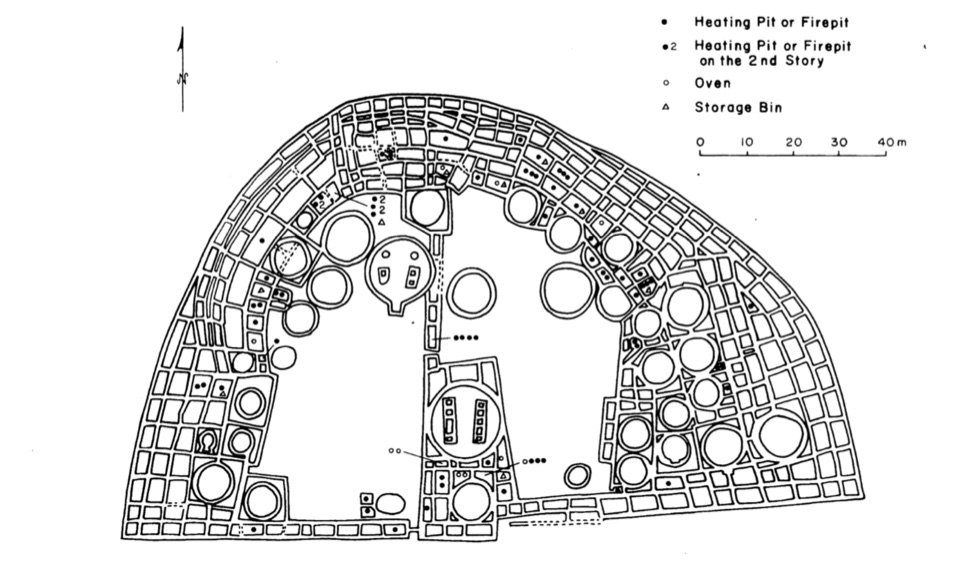 National Park Service (NPS) Measured Architectural Plan (Lekson 1984)
Chacoan T-Shaped Doorways, Pine Lintels & Type III Banded Masonry
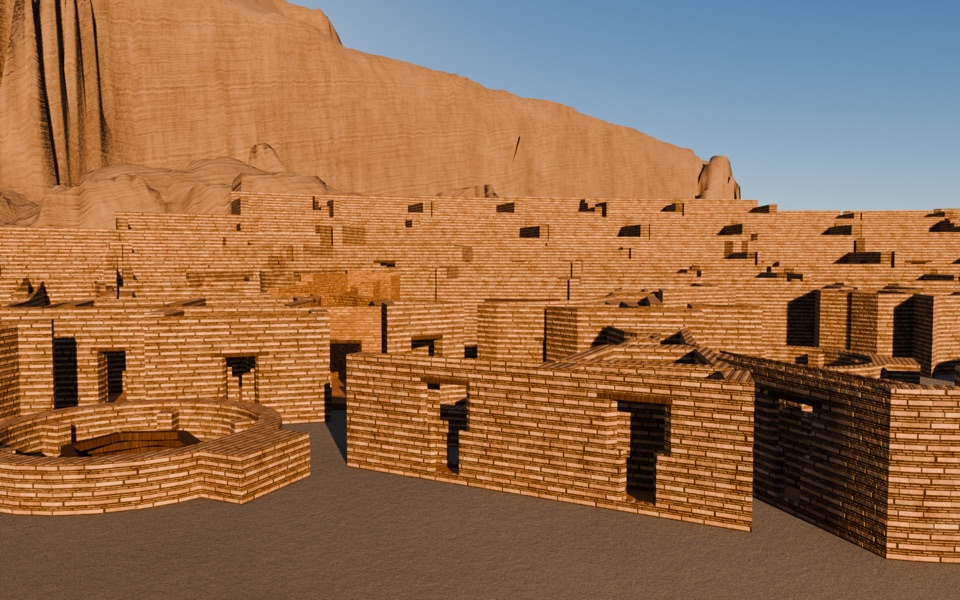 Blender Render: East Wing T-Shaped Doorways & Banded Ashlar/Spalls
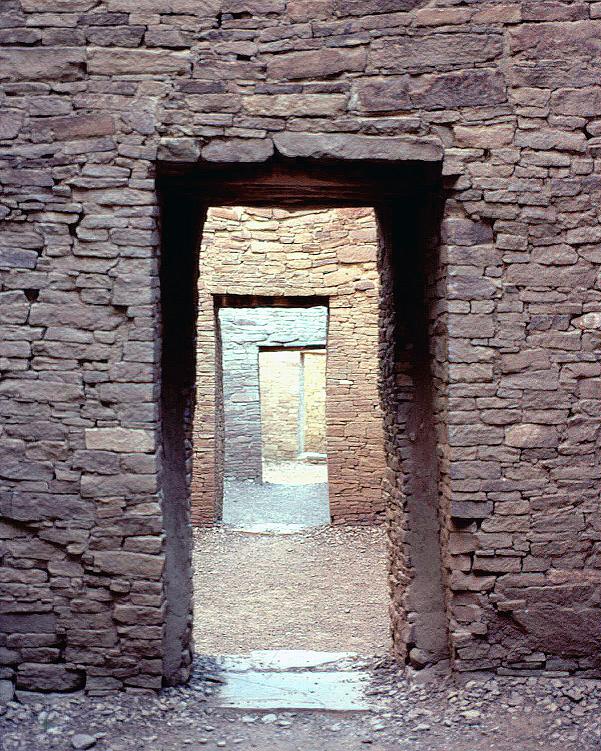 NPS / HABS Reference: Aligned Doorways at Pueblo Bonito (Public Domain)
HABS No. NM-30 (LOC Control No. nm0107) Measured Sections & 1877 USGS Survey Plan
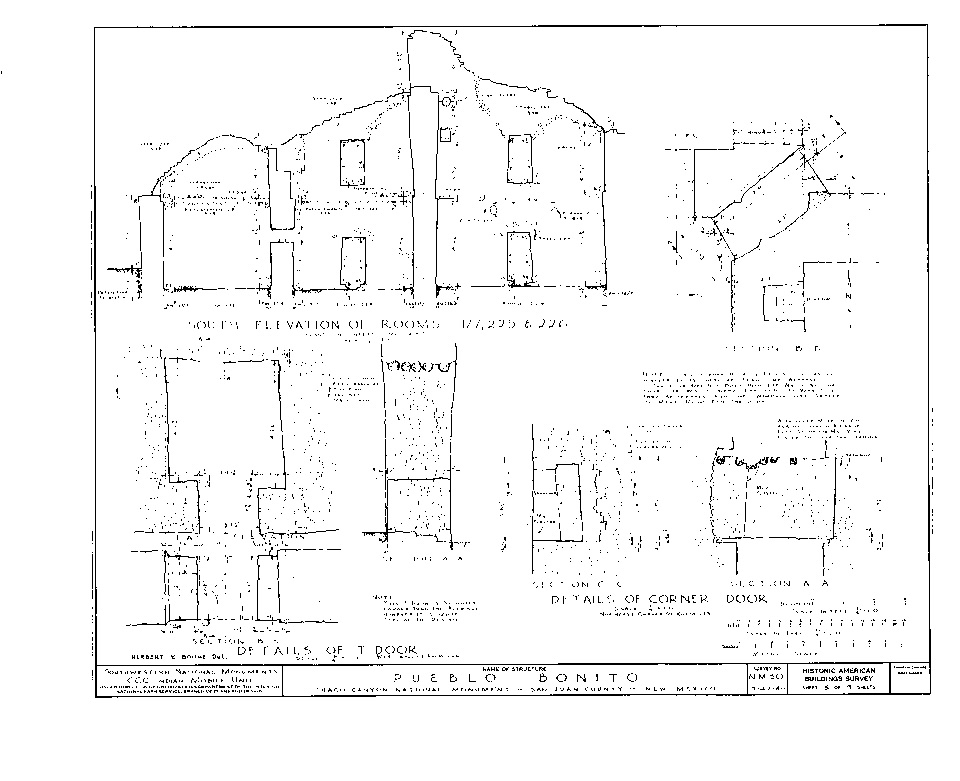 HABS No. NM-30 Sheet 5 (LOC nm0107, 1937): Section 1 (Rooms 174–177, 225–226) T-Door & Corner Doorway Elevations
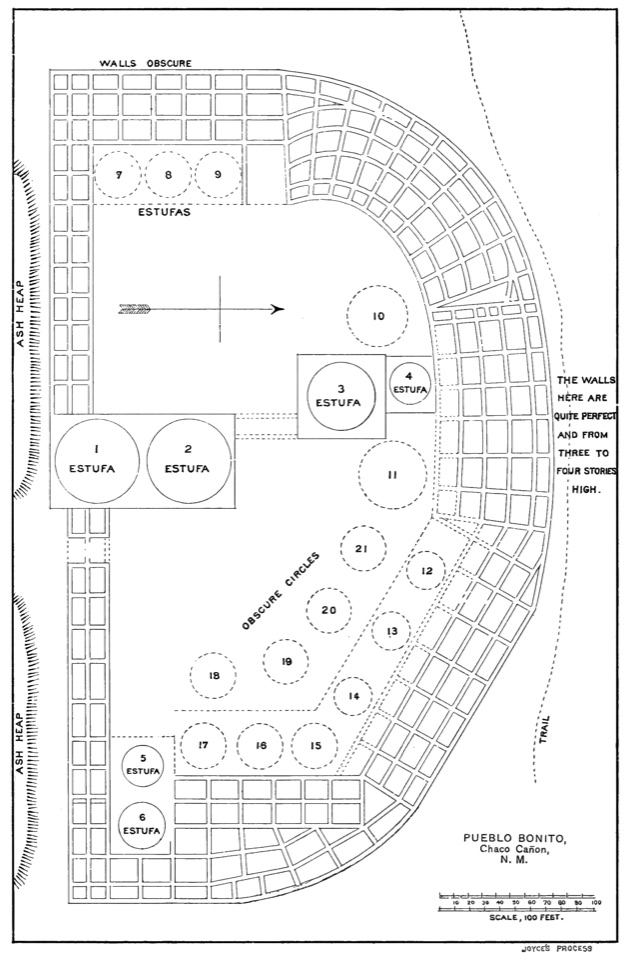 1877 U.S. Geological Survey (W.H. Jackson) Ground Plan of Pueblo Bonito
Reconstructed 4-Story Northern Spine, Threatening Rock (1941) & Analytical LiDAR Hillshade DSM
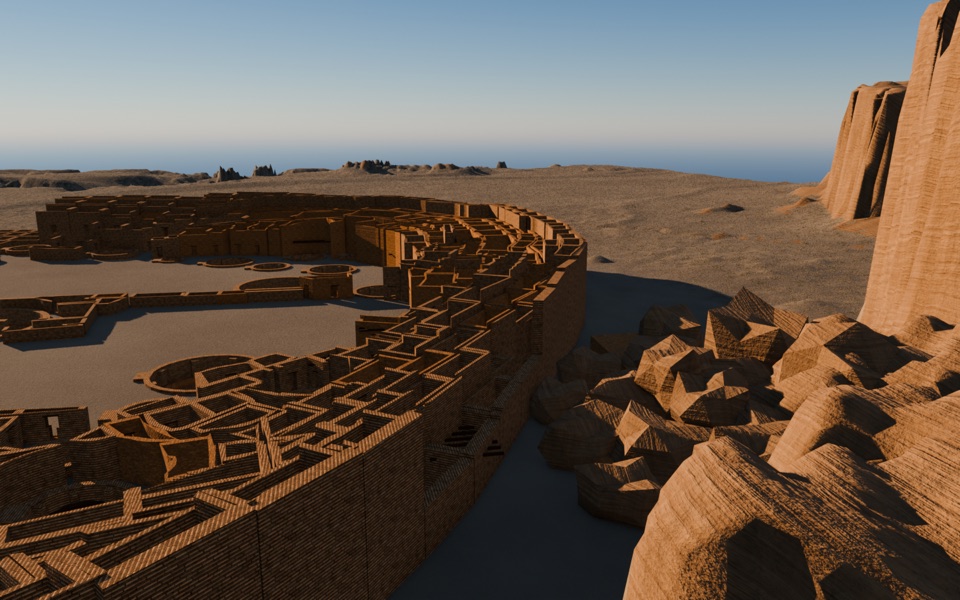 Reconstructed 4-Story North Arc & 1941 Threatening Rock Collapse Talus
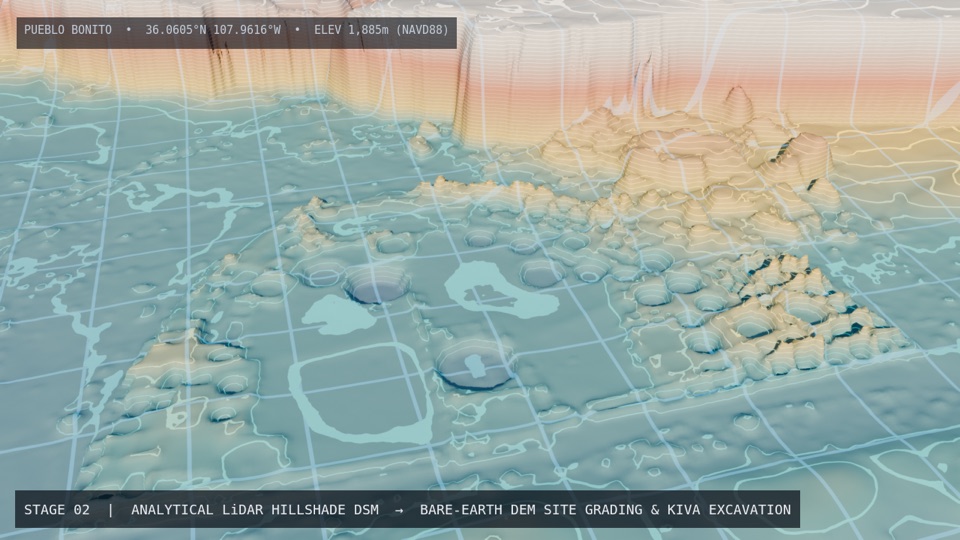 Stage 02: Analytical 0.5m LiDAR Hillshade DSM & Contour Grid
Fajada Butte Three-Slab Sun Dagger (29SJ297) & Cardinal Cosmology
Rising 135 meters above the southeastern entrance of Chaco Canyon, Fajada Butte (Tsé Diyilí) houses the Three-Slab Site (29SJ297) documented by Anna Sofaer in 1977 (Sofaer et al. 1979 Science 206:283–291). Three leaning slabs of Cliff House Sandstone (~2–3 m tall) channel narrow slivers of sunlight ("daggers") onto two pecked spiral petroglyphs on the cliff face behind them:
- Summer Solstice Noon (June 21): A single vertical light dagger pierces the exact center of the large 9.5-turn spiral petroglyph.
- Winter Solstice Noon (Dec 21): Two parallel light daggers bracket the exact outer left and right tangents of the large spiral, leaving its center dark.
- Spring & Autumnal Equinoxes: One dagger falls midway between the center and right edge of the large spiral, while a second dagger pierces the exact center of the smaller 2.5-turn spiral to the upper left.
- 18.6-Year Lunar Major & Minor Standstills: Moonrise shadow edges align with the center (minor standstill) and left tangent (major standstill) of the 9.5-turn spiral, with 19 diagonal grooves matching the 18.6-year lunar nodal cycle (Sofaer et al. 1982).
Across the canyon floor below, Pueblo Bonito, Chetro Ketl, and Casa Rinconada encode these same astronomical axes at monumental scale: Pueblo Bonito's central dividing wall and sightline across Chaco Wash to Casa Rinconada follow the true North–South cardinal meridian, while its southern closing wall aligns to the East–West equinox sunrise/sunset, and Room 228 (and adjacent Room 225) in the southeastern corner sector feature exterior corner windows aligned to the Winter Solstice sunrise (~120° ESE; Reyman 1976 Science 193(4257):1037–1038).
Interactive Sun Dagger Petroglyph Simulator
Uncoursed, unshaped thin tabular sandstone slabs (~3–5 cm thick) laid in abundant buff mud mortar without a rubble core. Preserved in the original 9th–10th century crescent surrounding Room 33 (the High-Status Matrilineal Crypt), Room 32, Room 28, Room 38, and the western Old Bonito block (including Room 326).
First true load-bearing core-and-veneer construction (~0.8–0.91 m thick): a rubble-and-mortar interior core faced with dressed sandstone blocks chinked with small tabular spalls to protect the mortar from high-desert rain erosion along the Northern Spine.
The signature aesthetic of Classic Bonito architecture: alternating horizontal bands of finely pecked rectangular ashlar blocks and multiple tight courses of thin, darker tabular sandstone chink spalls. Used in Great Kiva A, the East/West Wings, and Casa Rinconada.
Type IV features uniform courses of thin, tabular dressed stones with minimal chinking; McElmo style uses large, pecked, dimpled rectangular blocks of soft yellowish sandstone laid in double-wythe walls along the South Closing Arc and Pueblo del Arroyo's Hubbard Tri-Wall.